
No cheetah in Kuno National Park died due to radio collars: Project Cheetah chief SP Yadav
The Fact News Service
Sheopur (Madhya Pradesh), September 15
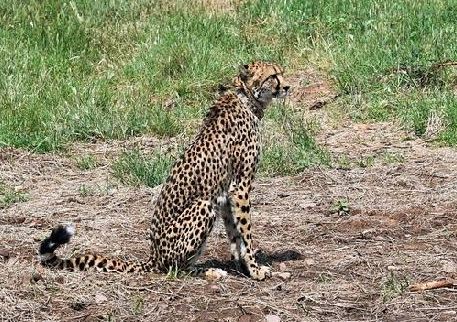
Amid some suggestions that possible infection linked to radio collars could be the cause of deaths of cheetahs at Kuno National Park, Head of Project Cheetah SP Yadav has said that “not a single cheetah died due radio collars”.
Yadav, who is also a member secretary of the National Tiger Conservation Authority (NTCA), told ANI in an exclusive interview on the completion of one year of reintroduction of cheetahs in the country, that carnivores and animals are monitored all over the world by radio collars and this is a proven technology.
“There is no truth that any cheetah died due to radio collars. I want to say that monitoring is not possible in the wild without radio collars,” he said.
“A total of 20 Cheetah were brought from Namibia and South Africa out of which 14 (adults) are completely healthy and are doing well. Four cheetahs were born on the soil of Bharat and one of them is now six months old and is doing fine. The three cubs died because of climatic factors,” Yadav told ANI.
Nine cheetahs died in Kuno National Park since March this year.
Yadav said no cheetah died at the Kuno National Park due to “hunting or poaching”.
“Generally, in other countries, poaching and hunting leads to deaths but our preparation was so good that not even a single cheetah has died due to hunting, poaching, or poisoning.. nor has any cheetah died due to human conflict..we have successfully achieved milestones in the past year,” he said.
“There has never been an attempt to move a cheetah from one continent to another and this was the first wild-to-wild translocation and there were a lot of challenges in it. Usually, in such long-distance translocation, a cheetah may die because it is a sensitive animal but no such death occurred here and the translocation was very seamless,” he added
Yadav said cheetah was reintroduced in the country last year after 75 years.
“If we look at the last year from the point of view of success, then the benchmark we had set has been achieved,” he said, adding that the survival rate of cheetahs has more than 50 per cent.
“Cheetah cubs have been born on Bharat soil. The process of adaptation to climate is going as per expectations and they are creating their own territory, fighting for their own territory, doing natural hunting, all this is happening…,” the senior official said.
Answering a query, Yadav said as per the MoU, South Africa is ready to provide 12 to 14 cheetahs every year.
Leave a comment
Related News









FACT News TV
View AllBreaking News
View All

LPU Jalandhar students Prashant Veer picked by CSK for 14.20...
December 27, 2025


Married woman shot at in Gurugram club for rejecting marriage...
December 26, 2025

Centre approves 3 new airlines after IndiGo fiasco: Al Hind...
December 25, 2025

Uddhav and Raj Thackeray Reunite: A New Chapter in Mumbai...
December 24, 2025
Advertisement

Editor’s Desk
View All


What led to the NDA victory in Bihar polls?
November 14, 2025

Punjab needs a comprehensive land-use policy
May 29, 2025